



Dermaroller and microneedling
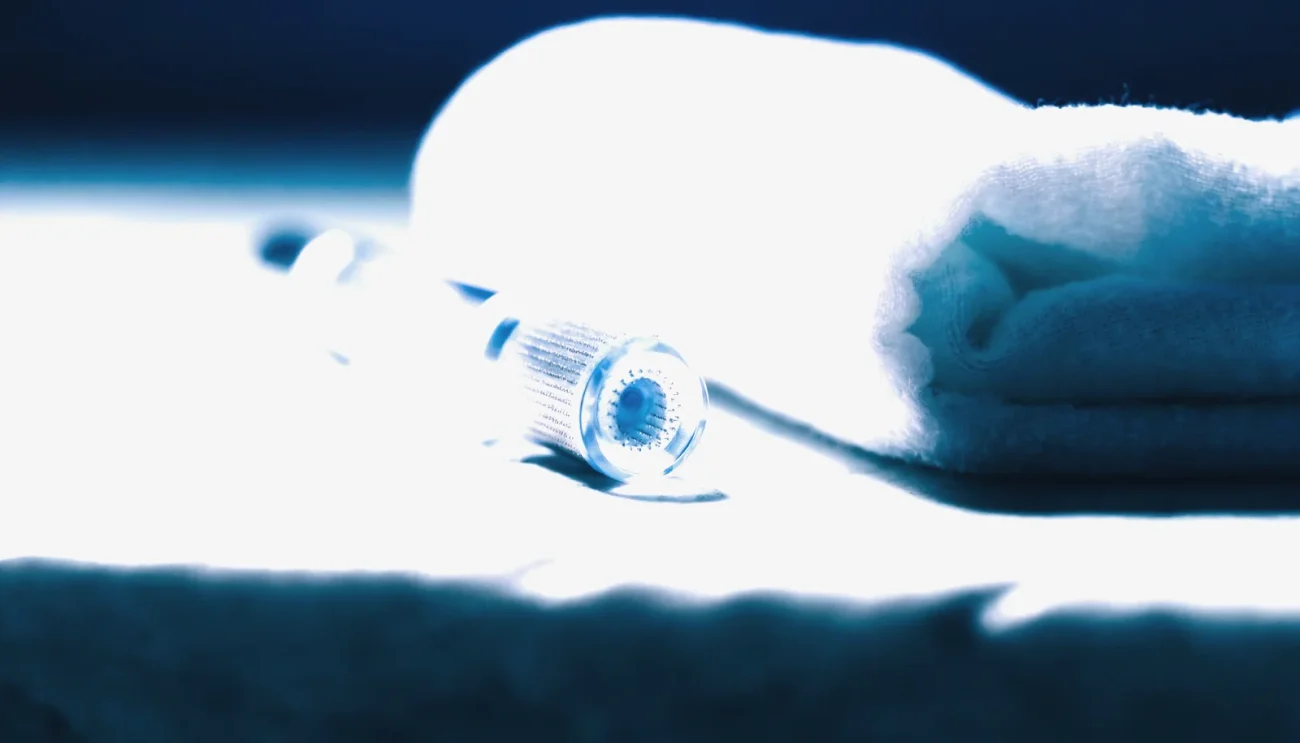
Scalp products have a problem that is rarely mentioned: the hair. The liquid you apply easily ends up on the lengths instead of on the skin. Microneedle applicators came about as an answer to this. This article explains how they are used, what the needle lengths mean and when microneedling is not for you.
Dermaroller and derma stamp: what is the difference
A dermaroller is a roller with needles that is rolled across the skin. The advantage is that it covers a larger area quickly. The drawback is that while rolling, the needles enter at an angle and drag across the skin, which on the scalp, between the hairs, can be uncomfortable and tangle the hair.
A derma stamp, or stamping applicator, is pressed straight down and lifted. The needles go in and come out at the same angle. It covers an area more slowly, but on the scalp it is more practical and easier to control.
There are also applicators with a reservoir, where the solution sits in the head itself, so it is applied in the same movement.
Needle length
This is the most important detail, and also the one most often skipped.
Home use calls for short needles. Longer needles belong to procedures carried out in a clinic, with appropriate skin preparation and conditions.
A practical rule: if you do not know how long the needles on your applicator are, do not use it until you have checked. The figure has to be stated on the packaging or in the manufacturer’s instructions. Longer is not better: longer means deeper, and deeper at home means a greater risk of injury and infection with no added benefit whatsoever.
How it is used
- A clean scalp. Wash your hair and wait until the scalp is completely dry. Do not use it on oily or unwashed skin.
- A clean applicator. Before and after every use. Follow the manufacturer’s instructions for cleaning.
- Part the hair. Work section by section, so that the applicator touches the skin and not the hair.
- Gentle pressure. No force. The aim is not for it to hurt.
- Be systematic. Go zone by zone, without skipping and without going over the same spot twice.
- After use. Do not rub the scalp, do not use aggressive products and do not expose the skin to the sun straight away.
How often
The skin needs time to recover between sessions. For home applicators with short needles, the instructions usually specify use at intervals, not several times a day.
Follow the instructions for the specific product. More often does not mean better: it only means the skin has no time to recover.
Hygiene
This is the part most often neglected, and the one that carries the most risk.
- The applicator is for personal use. It is not shared with anyone, not even once.
- Needles become blunt and bend over time. Replace the head according to the manufacturer’s instructions.
- Keep it dry, in closed packaging.
- If it has fallen on the floor, throw the head away.
When it is not used
Do not use microneedling on the scalp if:
- you have sores, cuts or fresh injuries on the scalp
- you have active inflammation, an infection, a fungal condition or pustular changes
- you have eczema, psoriasis or seborrhoeic dermatitis in an active phase in that area
- you are on therapy that affects blood clotting
- you have a clotting disorder or a tendency to keloid scars
- you have recently had a medical procedure on the scalp
- the scalp is red, painful or flaking for no clear reason
The last point matters: redness, pain and flaking can be a sign of a condition that calls for a dermatologist rather than for care. We gave an overview of these conditions in the article Alopecia.
What microneedling is not
It is not a therapy. The applicator is a means of application, not a medicine, and on its own it does not address the cause of hair thinning.
Nor is it a replacement for procedures carried out in a clinic. Home devices with short needles and medical procedures are not the same thing, however similar the names.
Which products it is used with
The applicator is used with a product intended for application to the scalp. What such products contain and how to compare two of them, we described in the article Hair serums and ampoules.
Do not use it with products that are not meant for the scalp, or with preparations containing alcohol in high concentration, fragrance or strong acids.
In short
A microneedle applicator solves the practical problem of applying a product to the scalp between the hairs. Needle length is a detail you have to know, hygiene is mandatory, and the list of conditions in which it is not used is not a formality. When you are not sure, ask a dermatologist before you start.
The SORA peptide hair set comes with a Hydra Needle applicator included.