



Blog
Rosemary oil for hair
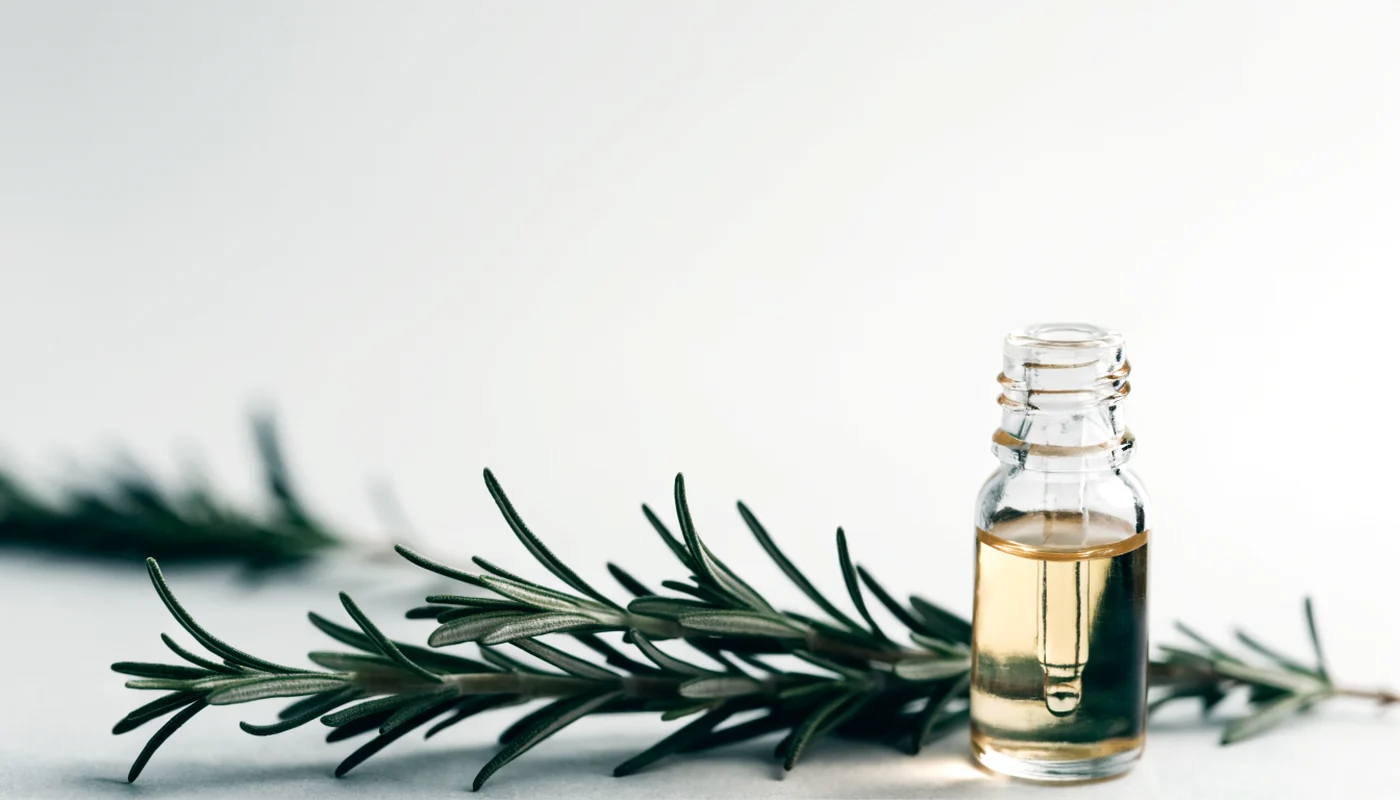
In recent years rosemary oil has regularly circulated on social media as a “natural solution” for hair loss. Behind that wave stands one specific piece of research, which in the retelling is usually simplified beyond recognition. It is worth looking at what was actually studied and what follows from it.
What rosemary oil is
It is an essential oil obtained by steam distillation from the leaves of rosemary, Rosmarinus officinalis (in more recent botanical nomenclature Salvia rosmarinus). The main components are 1,8-cineole, alpha-pinene, camphor and borneol, with smaller amounts of rosmarinic and carnosic acid present in other extracts of the same plant.
For essential oils one rule applies without exception: a concentrated essential oil is not applied directly to the skin. It is diluted in a carrier oil or used in a finished formulation in which the concentration has already been set.
Where the popularity comes from
The most cited source is a randomised study from 2015, carried out in men with androgenetic alopecia, in which rosemary oil was compared with minoxidil at a concentration of two per cent over six months. The result that gets passed on is that both groups showed improvement, with no statistically significant difference between them.
Along with that result come limitations that are almost always lost in the retelling:
- The sample was small and the study a single one
- There was no group receiving nothing, so it is not known how much of the improvement is due to the application and scalp massage themselves
- The comparison was made with a lower concentration of minoxidil
- The results have not been confirmed by larger, independent trials
- Six months is a short period for assessing a chronic condition
There is also preclinical research in animal models and in vitro examining the effect of individual rosemary components. Such results are useful as a pointer for further research, but they do not translate automatically to humans. For context on how evidence is assessed for a registered medicine, see the text on minoxidil.
What can realistically be said
The current state of the evidence is best described as “interesting but insufficient”. In cosmetics rosemary oil is used for its scent, its antioxidant profile and the feel on the skin. The claim that it treats alopecia or replaces a registered medicine has no basis and, when it appears on the packaging of a cosmetic product, is not in line with the regulations.
Part of the reported improvement probably also comes from the routine itself. Regular scalp massage several times a week, together with more careful handling of the hair, has its own effect regardless of what is applied.
Safety and precautions
“Natural” does not mean “harmless”. Essential oils are concentrated mixtures of active compounds and have their own limits:
- Undiluted rosemary oil can cause irritation and contact dermatitis
- A patch test on a small area of skin 24 to 48 hours before the first wider application is recommended
- Contact with the eyes and mucous membranes is avoided
- It is not applied to damaged, inflamed or injured scalp
- Pregnant and breastfeeding women, as well as people with epilepsy or high blood pressure, should consult a doctor first
- It is not used in young children without a paediatrician’s advice
- It is not applied immediately after chemical hair treatments or to an irritated scalp
Product quality
The composition of an essential oil varies depending on the chemotype of the plant, the climate and the distillation method. Dilutions and blends sold as pure oil are also found on the market. A label stating the Latin name of the plant, the part used and the extraction method gives at least basic verifiability.
How it fits into a routine
If you decide to use it, the usual approach is dilution in a carrier oil, for example jojoba or coconut, at a low concentration, application to the scalp, a short massage and rinsing off after a certain time. Oils left on overnight on an oily scalp can make things worse, so a shorter contact time is often recommended.
It is also worth keeping the order in the routine in mind. An oily base makes it harder for water-based formulations applied after it to penetrate, so oil treatments and water-based serums are usually not combined in the same step but separated.
In short
- The popularity comes from one small study from 2015 whose limitations are rarely passed on.
- The evidence is preliminary; independent confirmation in larger samples is missing.
- An essential oil is never applied undiluted to the skin.
- Irritation is possible; a patch test on a small area is a sensible first step.
- Pregnant and breastfeeding women and people with chronic conditions should consult a doctor.
- Rosemary oil is a cosmetic ingredient, not a medicine, and does not replace a medical work-up.
This text is informative in character and does not constitute medical advice.